Identity on display
What a prison backpack says before its owner ever speaks
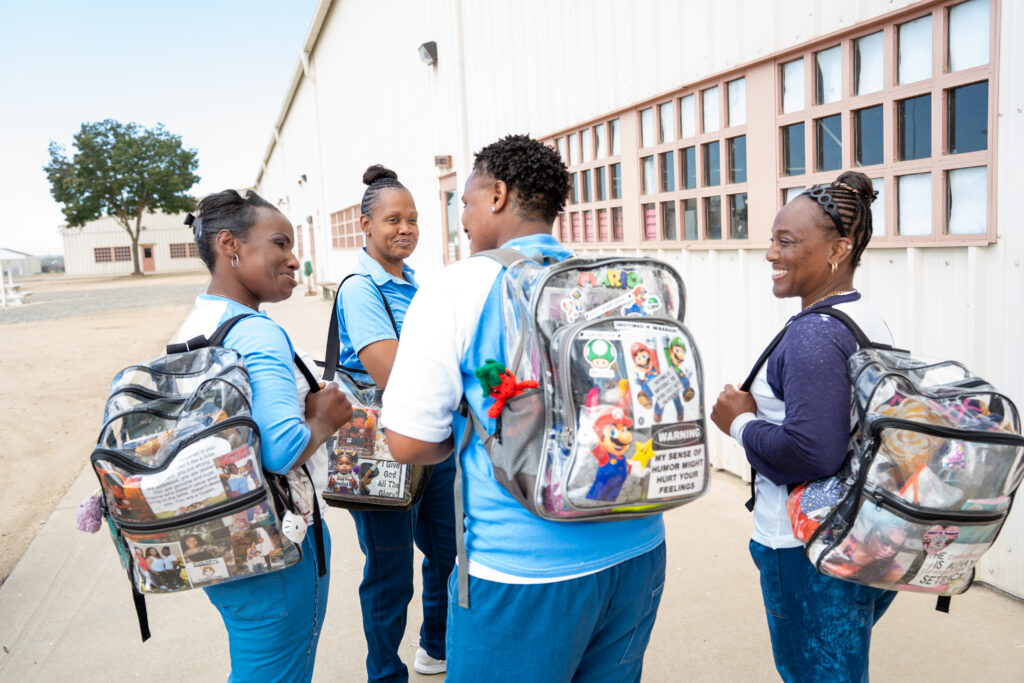
In both of California’s two women’s prisons, Central California Women’s Facility (CCWF) and California Institution for Women (CIW), clear backpacks have become cherished accessories. The trend started post-COVID, when programs started donating them as an incentive item for events like graduations.
But a clear backpack is never just a clear backpack. Yes, it carries the basics, especially for the many residents attending college: notebooks, folders, pencils, schoolwork, maybe a few daily essentials. But over time, that backpack becomes something much bigger for the person who carries it.
Like a turtle carrying its shell, many women move through prison with their world on their back. But this shell is transparent. It is decorated. And therefore, it becomes personal.
“What makes the cut into that front display pocket is never random,” said CCWF resident Vanessa Celaya. “That space is prime real estate, it says something about me and every visible space has to earn its place.”
In a place where so much is regulated, limited, and uniform, a clear backpack is one of the few spaces where a woman can still quietly say, this is me. A mini museum of personality; a front-window display of the self.
Women carefully choose what belongs there, knowing those items will be seen. A family photo, an encouraging quote, colorful pens, a prayer card, a handwritten note, a symbol of hope, or a favorite essential can all reveal something meaningful. These backpacks are not thrown together. They are curated. They tell stories about memory, survival, style, hope, and selfhood.
The bag may be clear, but the story inside is layered. Before a woman even says hello, her backpack has already spoken.
Sabrina Limon, resident of CIW, decorates her backpack with personality and a fun energy. Whether it be a splash of color, a meaningful quote, or a picture of her kids, it shows her vibe and what it matters most to her.
“Positive quotes like ‘Good Vibes Only’ represent what I believe and the energy I want to share with no words spoken,” Limon said. Her backpack is one of the few spaces where style, memory, and identity get to breathe.
Some women decorate their backpacks because it helps them feel human in a place that often feels dehumanizing.
CCWF resident Amber Leal shared her disappointment of not having a backpack for school.
“Having one will help me feel organized, productive, and most of all human,” Leal said. “It can restore my sense of self.”
For Leal and many others, having a backpack could be a reminder that even in a controlled environment, a woman still has taste, personality, memories, and preferences.
Others do it for comfort, something that will help a woman feel grounded during a difficult day.
CIW resident Brenda Armstrong said that the pictures and quotes she places on the front of her backpack are the things that represent hope, courage, resiliency, and love.
“I display these on my front pocket because I know they might be able to lift somebody up if they’re having a bad day,” Armstrong said. “They are also reminders to myself to keep going and stay focused because there is light at the end of the tunnel.”
That backpack may be the closest thing to portable emotional support Armstrong has. It travels with her to class, to programs, and across the facility. In that sense, it becomes more than storage. It becomes emotional equipment.
And for some it is about motivation.
A planner may represent discipline. A quote may represent healing. A photo may represent purpose. A scripture may represent strength. For Jessica Williams, a resident of CCWF, displaying a photo of her sister in a Navy uniform gives her motivation. “It is a reminder that you can do anything you put your mind to,” Williams said.
The choices of decorating the backpack matter because choice itself matters.
These small acts of self-expression become powerful. That is why the backpack becomes a kind of social introduction too.
Another CIW resident, Rachel Henderson, shared that she changes the images and quotes on her backpack every now and then, depending on her mood.
“It is a way of creating connection and sharing conversations,” Henderson said. “I don’t know how many times I’ve had someone tell me they liked the quote on my bag and it started up an interesting conversation.”
Women notice each other’s bags. They read them. They respond to them. A backpack can say, I am healing. It can say, I still know who I am.
Some backpacks are bright and full. Others are neat and minimal. Some are carefully color-coordinated. Some are packed with memory. Some are strictly practical. But all of the them, in one way or another, tell a story.