From a badge to scrubs
Why registered nurse Chaverri made an unusual career change

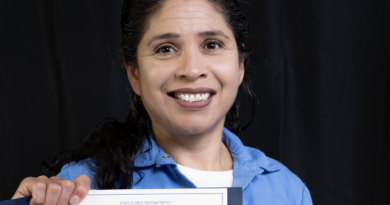
Registered Nurse (RN) A. Chaverri walks in her scrubs through the Central California Women’s Facility (CCWF) B Yard program office Monday through Friday at 7:30 a.m., like clockwork. She moves fast enough to get to work on time yet slow enough to smile as she passes residents and greets the correctional officers.
Some mornings, residents are standing outside of the clinic in hopes of getting a brief word in before she starts her day. Though they may not be on her clinic line, she takes the time to answer their questions. It’s a simple act of kindness, a day changer for most.
Chaverri has not always worn scrubs and a smile. Once she wore a green uniform, a belt with keys and a serious face that wasn’t always inviting for CCWF residents. She meant business; she enforced rules and set boundaries. Her boundaries were well-known and consistent to everyone. Some residents appreciated the consistency of Correctional Officer (CO) Chaverri.
“As an officer, she still displayed empathy. She was strict but nice,” said resident Karina Poncio. So, it was no big surprise she became an RN.
Chaverri has been with the California Department of Corrections and Rehabilitation for approximately 18 years. She began as a CO back in 2008, was licensed as a registered nurse in 2017, and began working in the medical field in 2018.
When asked why she changed careers, she said, “I was going through something in my personal life and wanted to do something that made me happy. I always liked the medical field. I prayed about it, and the answer was clear and connected. It changed my life.”
Today, Chaverri works with about six other medical staff, a few dentists and a CO. No matter who else is there day to day, Chaverri’s office is inviting due to her personality.
Chaverri makes space for residents to ask questions, feel safe, and know they do have an ally for their health in their corner.
What Chaverri likes most about working as an RN is that she is able to use her specialized knowledge. With that knowledge she can help people when they are scared and anxious and just need someone to be there. Chaverri also feels she can help the population navigate the medical process, as she takes time to explain it to them. That kind of attention is easy to give because she is a part of a team responsible for giving health-related care, and she already had a rapport with the incarcerated population.
Residents have great things to say about Chaverri. “She really takes the time to talk to people, and she believes in our change,” Poncio said.
Diana Estrada, another resident from B Yard, recently went to see Chaverri. “She made me feel comfortable, safe and understood,” Estrada said.
Chaverri explained that when she was a CO, the work was in some ways more informal. She considered herself straightforward and consistent. Most days her goal was to get through the day without incident.
“When I opened the door for chow,” she elaborated, “people knew my program in that when it’s time to come out, you come out. That’s it, no back and forth. I didn’t care about excuses, I didn’t care about games.”
Chaverri said her current job as an RN is more formal, more precise. Responding to medical emergencies, like chest pain, there are specific guidelines that must be followed. But explaining the reasons the pain might be happening, and the next steps that a patient can take to address the condition, requires a human connection.
“I think of it as being thorough,” Chaverri described her approach. “People want to know what is happening, especially if there are limited resources. There are reasons you could be having chest pain. I demonstrate and explain those reasons.”
Here in CCWF it is not rare to have incidents. But it is rare to build professional rapport between staff and incarcerated folks, like what Chaverri has cultivated. Residents who have been at CCWF for a long time have seen that if rapport is built, incidents are less likely to occur. Having rapport in prison helps to keep people safe. And healthy.
When asked if her change of career changed the way she sees residents, Chaverri responded, “It definitely did,” through time and experience.
“I’m almost 20 years in,” she said. “I know my delivery [today] needs to be a little softer and more thorough in order to get it done.”
Chaverri also noted how time and experience changes residents too, mentioning the positive impact of taking advantage of college, certifications, the Occupational Mentor Certification Program, and other programs.
“There is a huge divide between people who do and don’t program, between the newer people coming in and those who have been around for a long time,” she said.
No matter who the patients are she treats, Chaverri aims to give them the time they need to understand their condition.
“It is about knowing how to deliver the information to a patient and engaging in questions that can maybe be helpful to them even when they refuse,” she said. “I would not go back to being a correctional officer.”