
A constitutional right to rehabilitation
How did Alaska become a more progressive state than California?
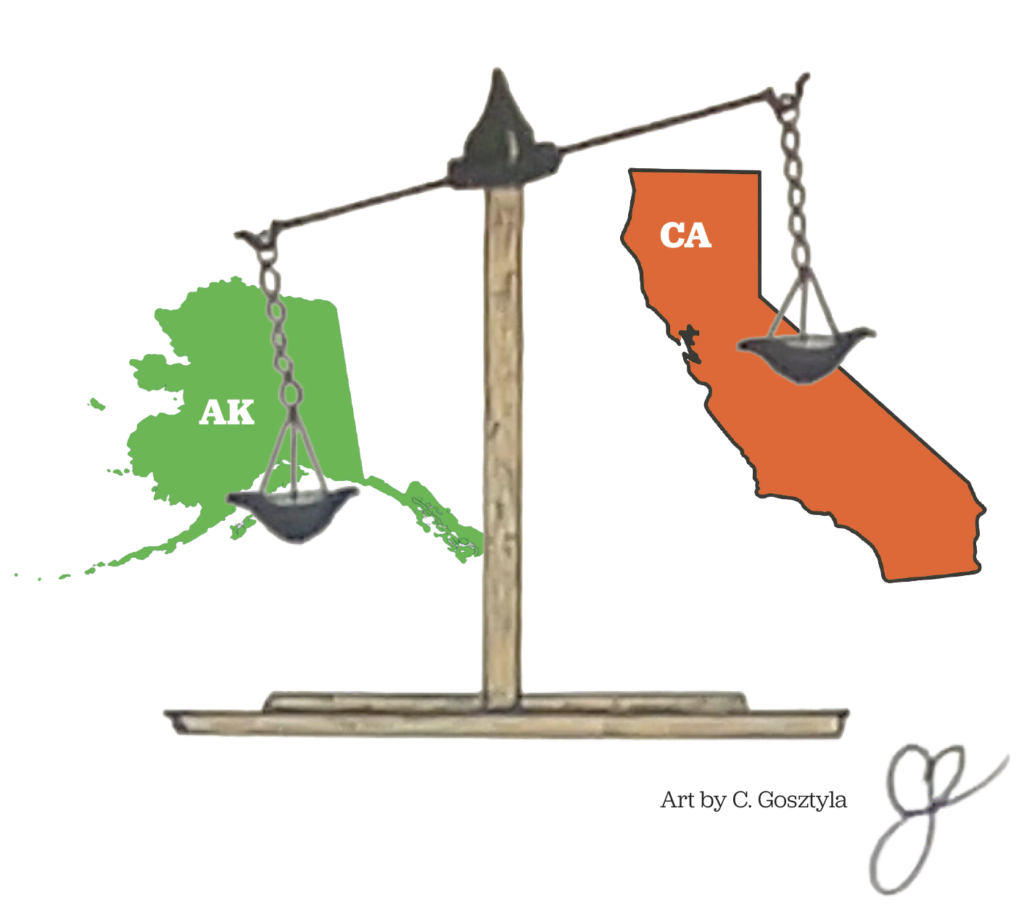
For the past 20 years, California has been involved in the national trend of criminal justice reform. A key moment happened back in 2005, when the California State Legislature added the “R” to CDCR – becoming the California Department of Corrections and Rehabilitation. Before this reform, people would literally spend the rest of their lives in prison — reports Kevin Sawyer in the San Quentin News.
Nearly 15 years after adding the “R,” the California legislature finally made a significant reform that aligns with the concept of rehabilitation by declaring that they, “[Recognize] that long sentences do not deter the crimes they are intended to deter.”
This led them to amend Penal Code (PC) 1170 in 2019 to clarify that when sentencing someone to prison, “The deprivation of liberty satisfies the punishment purpose of sentencing. The purpose of incarceration is rehabilitation and successful community reintegration achieved through education, treatment, and active participation in rehabilitative and restorative justice programs.”
Further penal reform in 2026 enacted PC 5000.5 to state, “the purpose of incarceration is rehabilitation accomplished only if the period of imprisonment is used to maximize personal growth for all residents and facilitate their reintegration into society upon release, enabling them to lead law-abiding and self-sufficient lives, reducing recidivism.”
One state California could learn from is Alaska, the only state to provide a constitutional right for rehabilitation to its incarcerated population. Alaska is the only state to abolish both the Death Penalty and Life Without Parole (LWOP). California, however, actively issues both of these extreme sentences.
How did Alaska become a more progressive state than California and the rest of our nation?
In 1957, Alaska abolished the Death Penalty for all crimes. Just over a decade later, Alaska added section 12 Criminal Administration to Article I of its Constitution. This provision specifies that the administration of criminal justice “shall be based upon the need for protecting the public, community condemnation of the offender, the rights of victims of crimes, restitution from the offender, and the principle of reformation.”
It is the last three words, “principle of reformation,” that put Alaska in the lead of progressive justice, since they provided a foundation for the landmark Alaskan Supreme Court decision, Abraham v. State.
In the 1970s, Mickey Abraham, a person incarcerated in Alaska because of a crime committed while intoxicated, filed an appeal. Among his grounds for relief was the lack of treatment for his alcoholism while detained.
The case made its way up to the Supreme Court of Alaska, where the Court determined that “Abraham has a constitutional right to rehabilitative treatment – particularly with respect to his consumption of alcohol.”
In 1978, the Alaska Supreme Court concluded in Abraham v. State that prisoners in Alaska have a constitutional right to rehabilitation. They further clarified that if the offender is rehabilitated, it also advances the public interest — creating a safer society overall.
In 2008, the Supreme Court’s decision on the matter led Alaska to abolish LWOP for all crimes and entitled all offenders to an opportunity for parole.
The same can’t be said for California.
Nearly two decades later, Californians continue to fight excessive sentencing through the “DROP LWOP” campaign. There is a difference between the purpose of prison being for rehabilitation, and the constitutional right to rehabilitation.
The wording in California’s PC 1170 is contrary to Death Penalty and LWOP sentences because those sentences do not afford the individual an opportunity to prove their rehabilitation before the Board of Parole Hearings. Currently, the only recourse left for LWOP and Death Penalty cases to prove they are rehabilitated is a commutation by the governor. Only 106 death penalty sentences, all between 1893 and 1967, have been commuted in California, according to University of the Pacific, McGeorge School of Law. And fewer than 200 LWOP sentences have been commuted over the last 30 years, CalMatters reported.
Using legislators’ words against themselves poses a moral question: If incarceration serves the “punishment” function of sentencing, and the purpose of prison is “rehabilitation and successful community reintegration” back into society, then how can Californians morally continue to allow the Death Penalty and LWOP? If Californians want to stake a claim at being a progressive state, then constituents need to utilize the power of their voices and inform their district legislators – let’s catch up to Alaska in this era of criminal justice reforms!
How is it that the California Legislature can claim that the purpose of incarceration is rehabilitation for all residents and facilitate their reintegration into society — and yet continue to detain people with Death Penalty and LWOP, much less continue to pass out these contradictory sentences?