A messy situation
The state of menstruation in women’s prisons
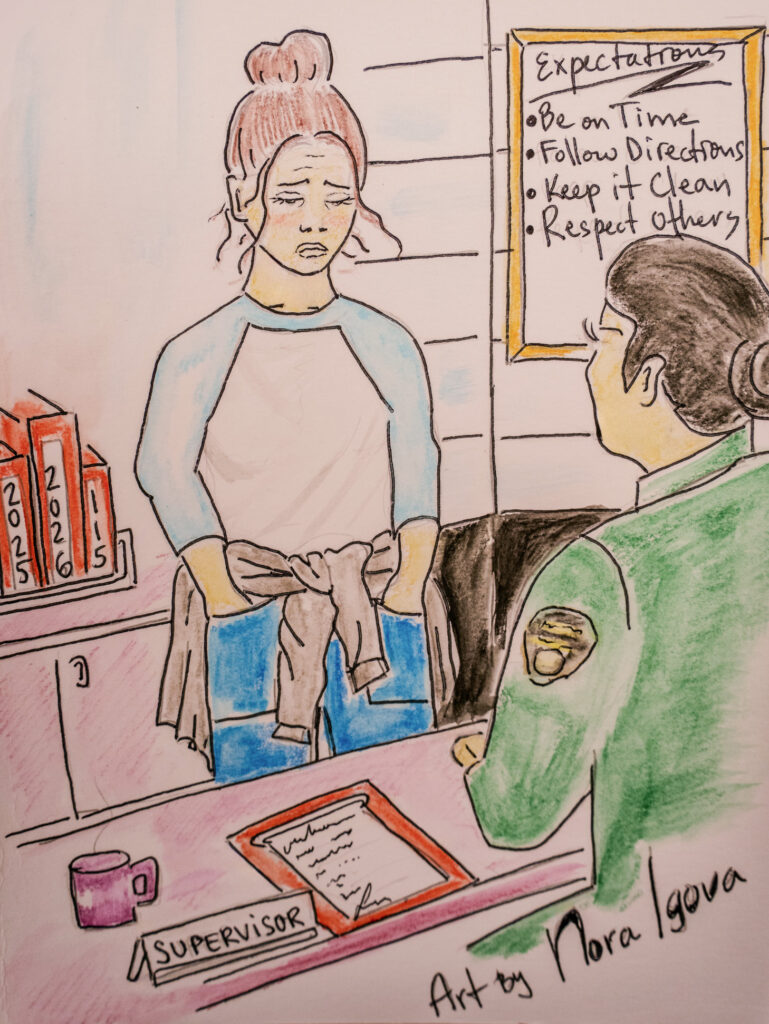
It was a fast-paced work day in the then-called Prison Industry Authority Dental lab at Central California Women’s Facility (CCWF) back in 2020. Resident worker Crystal S. [full name withheld for privacy] was exceeding her production goals when suddenly she felt an unsettling sensation of wetness. She ducked into the restroom to mitigate the damage, but it was too late; she’d fallen prey to…leakage.
Crystal tied her state sweatshirt around her waist, then asked permission of the lab supervisor (who on some days could be a man) to return to her housing unit to change clothes. After waiting awhile, she was then questioned by the Work Change officer, who required her to undergo a stripsearch, to verify that she wasn’t lying about needing to leave work. “I was humiliated,” said Crystal. “Not only did she see my body, but my used pad. It’s a perversion of power to make me strip for this reason.”
When asked for comment, the Office of Public and Employee Communications (OPEC) indicated that no grievance was filed regarding this incident. “Performing a body search when leaving a work program to enter into another facility is standard practice.” They further stated that the Department Operations Manual “provides guidance as to when and how a body search is to be conducted” and “incarcerated persons assigned to designated areas… may be subject to unclothed body searches before returning to the institution’s general population.”
A period leak is an unwelcome occurrence for any woman. But being incarcerated can escalate an inconvenience into a debacle. And the odds are against us given the inferior quality or even availability of menstrual provisions.
According to a 2024 Prison Policy Initiative (PPI) special report, approximately 196,000 women and girls are incarcerated in the U.S. It’s a small percentage of the total national prison population but still a large number—and it has risen at double the rate of men’s imprisonment since 1980, the Sentencing Project reports. So, it’s not surprising if prison and jail systems are often unprepared to provide for the specific health needs of women, including menstruation. I would consider provision for this biological need to be an afterthought. No matter what, it’s a messy situation.
Availability Guaranteed?
The PPI report indicates that prisons restrict access to products through paltry allotment, unattainable pricing, or disciplinary action. That’s true in states across the map.
A 2020-2022 survey by the Journal of Women’s Health found that 54% of Missouri state prisoners had inadequate supply. Of those 94% had traded food, hygiene items or favors for menstrual products. 67% had used alternative materials like rags, clothing, or toilet paper.
The Journal of Women’s Health also found that more than half of New York state prisoners have insufficient menstrual supplies, and that products are of poor quality and prohibitively expensive.
Lawmakers in Congress and in 25 states, including California, have responded by passing laws that require free access to menstrual products, according to a 2024 article published by the Robert & Ethel Kennedy Human Rights Center.
“CCWF provides free and unrestricted access to menstrual products without needing to request them. Menstrual products are located in the dayroom of each housing unit providing easy accessibility,” said OPEC.
In states without such laws, or in non-compliant facilities, prisoners must buy products, which creates hardship since incarcerated pay rates are meager.
In California, quarterly vendors offer products of standard market quality but at prohibitive cost. Walkenhorst’s, a popular vendor with CCWF residents, charges $7.50 for about one week’s worth of Always regular pads with wings, $7.95 for Kotex regular tampons, $7.25 for Tampax regular or super tampons, $3.50 for Stayfree maxipads, and $1.95 for Kotex long pantyliners. Another vendor, AccessSecurepak, charges $8.95 for Always pads with wings, and $4.95 for Tampax regular or super tampons.
At a pay rate of 35 cents per hour, one box of tampons costs over 21 hours of work.
Alternatively, woman may barter for products, or go without, according to Tanesha Golding, who has advocated with the Georgia Women’s Policy Institute to improve access to menstrual products.
Quality Questions
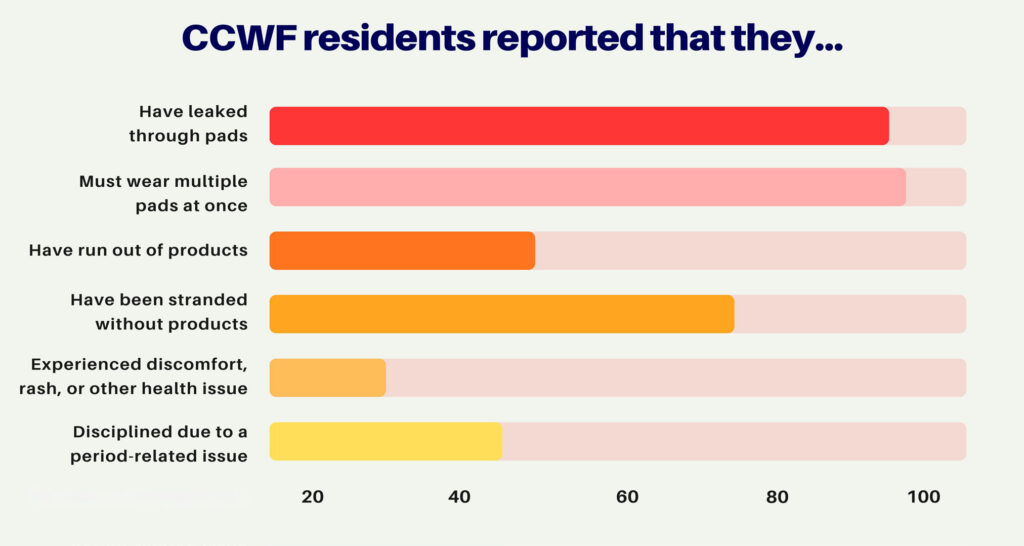
National and local surveys such as those conducted by The Prison Flow Project reveal that most women leak through the provided pads and tampons. Needing to use multiple pads increases scarcity – not to mention discomfort.
Menopause, hormone imbalance, stress, use of an intrauterine device, or sudden sobriety can bring heavier burdens.
When Oklahoma prisoner Geneva Phillips was in menopause, she was “going through a super tampon and a pad in an hour, every hour.” Phillips told Prison Journalism Project contributor Kelsey Dodson that she had to stay on her bunk during long count procedures and she consequently bled through her clothes to her bedding.
Fibroids can cause similarly heavy bleeding, as Evelyn [last name withheld], a formerly incarcerated woman, told the Texas Criminal Justice Coalition. “It was so embarrassing and shameful,” she said. “I would get up early and wash myself, my clothes, and my sheets, even though this was against the rules.”
In a 2019 PPI analysis of all states plus Washington D.C. and the Federal Bureau of Prisons, some prisoners reported needing to change the pads as frequently as every 30 minutes on heavy-flow days. Over a quarter of respondents said they’d used materials like towels, socks, shirts, or toilet paper to stem the tide.
Here in California, pads and tampons come in only one size each; Out of 182 women in the facility surveyed by CCWF Paper Trail, 98% found them to be less absorbent than a “regular-sized” product in the free market. The pads are 8 x 2.5 inches and 1/8 inch thick. There is no dry, woven top layer for efficacy and sanitation. There are no “wings” to cover or line the sides of the underwear, leaving a gap that invites leakage. The majority of CCWF survey respondents need to tile several pads together at once, especially overnight.
Periods and Punishment
Prison rules related to menstruation can constitute a setup for infractions. For example, the PPI analysis shows that if women aren’t given enough pads and they leak onto bedding as a result, they may be disciplined for damaging state property. Or the inefficacy of products forces women to use alternative materials, leading to disciplinary action for use of “contraband.”
Rule infractions reported by the PPI may also include “neglecting personal hygiene” or “skipping work” (without an official medical excuse).
Disciplinary actions often exacerbate the situation, through confiscation, reduced supplies in solitary housing, restricted access to showers or commissary, or fines which preclude buying necessities. These also can introduce health risks resulting from McGyvered attempts to manage a physiological process.
Health Risks
A 2023 criminal system survey by the Journal of Women’s Health found that roughly half of respondents had to use products for longer than safe or recommended by manufacturers. About a quarter reported negative health outcomes as a result.
The Journal’s resulting report, Menstrual Equity in the Criminal Legal System, summarized multiple studies by concluding, “Wearing a tampon for longer than the recommended duration or using unclean [alternatives]…increases risk for intravaginal dysbiosis, infection, and toxic shock syndrome.”
California’s tampon package insert states, “TSS is a rare but serious disease that may cause death. There are scientific studies that have concluded that tampons contribute to the cause of TSS.”
Standard warning is a list of preventive actions. Four of these are often not possible in our prisons:
“Use the lowest absorbency for YOUR flow.” Available absorbencies listed are “Light (less than 6 grams), Regular (6-9 grams), Super (9-12 grams) and Super Plus (12-15 grams).”
“Do not extend the wear time by using higher-absorbency tampons and change tampons at least every 4-8 hours.”
“It is preferable to avoid using tampons overnight and use a pad instead.”
“Alternate tampons and pads to avoid continuous use of tampons.” (Many find it necessary to use tampons and pads together.)
The Columbia Journal of Gender Law noted in 2021 that health risks are exacerbated for incarcerated women due to the additional emotional trauma of asking for “subpar menstrual products,” which discourages them from asking. The Journal also cited this situation as a violation of the United Nations Declaration of Basic Principles for Treatment of Prisoners.
Is a Remedy Possible?
Laws are a great start, but first-hand reports collected by The Prison Flow Project disclose that some prison staff ignore or deliberately reinterpret the laws, and there is no oversight.
“Some of [these] issues have…everything to do with a fundamental refusal to let prisoners have dignity,” opined author and former prisoner Keri Blakinger in a 2022 CNN Opinion article.
Golding elevates this concept by framing provision for menstruation as “a human rights concern that transcends both criminal justice and women’s rights domains.” Accordingly, she continues her work to provide free products for women in Georgia prisons.
While in California we can be grateful for free supplies, wouldn’t it make sense to raise the quality of products to where their purpose is fulfilled – to absorb and protect?