How books get banned
Law requires CDCR to provide clear reasons for its disallowed book list but, our writer argues, making sense of the list is more complicated
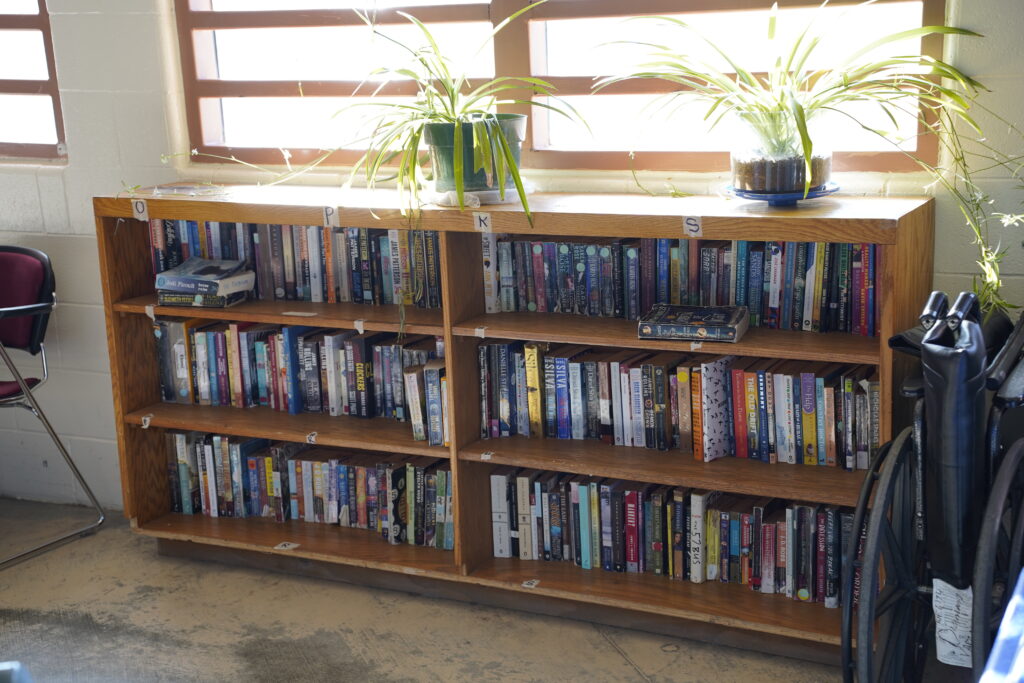
Thanks to the presence of our Recreation Library with its Book Club, and unit libraries provided by Freedom Reads, books play an important role in creating community at Central California Women’s Facility (CCWF).
Still, access to books inside prisons is complicated, due to state and federal regulations. And the list of books allowed inside California prisons — the Centralized List of Disapproved Publications — is constantly changing.
The California Department of Corrections and Rehabilitation published the most recent version of the list on its website on April 1, 2026. It contains 179 pages of books, magazines, and other publication titles, along with the reasons for their exclusion.
Based on this new list, the CCWF library staff were required to pull approximately 75 titles from the shelves. One recent addition to the list is a special-collection printing of a book from the CCWF Book Club: The Fourth Wing, Wing and Claw Collection, The Empyrean, from 2025.
(Thankfully, other paperback editions of the book are still allowed.)
The reason provided for banning this particular book was that it “lacks serious literary, artistic, political, or scientific value.”
This justification can be found in the California Code of Regulations, Title 15. In the sections on contraband, you will find multiple subsections that explain the “what and why” for material that has been deemed unacceptable for incarcerated persons to have.
But this rather strange phrasing has an even older origin, based in federal law. In Roth vs U.S.(1957), the U.S. Supreme Court established guidelines to determine what material counts as obscene; namely, would “…the average person, applying contemporary adult community standards” consider that:
1. The matter, taken as a whole, appeals to prurient interests.
2. Depicts or describes sexual conduct in a patently offensive way.
3. Whether a reasonable person finds the matter, taken as a whole, lacks serious literary artistic, political, or scientific value.
The justification for putting many of the titles on the disapproved publication list can be considered self-explanatory: weapons, weapon building, explicit sex, gang-related material, gambling, etc. However, it is difficult to comprehend the inclusion of others.
Take National Geographic, for instance. Forty-one different issues of National Geographic from as early as 1972 up to 2025 appear on the list, despite it being listed in the Title 15 as a publication that “shall be allowed.” The subsection reasons listed do vary, and some meet the criteria for disapproval. However, I am personally baffled and offended that the some of the disapproved issues were considered “lack[ing] serious literary, artistic, political or scientific value.” Really?
How does National Geographic appear on the list, but not any encyclopedias? Or, dare I say, the Bible?
Cain and Abel, Moses and his people being forced to slave and suffer for 40 years. The adulterers in Sodom and Gomorrah. The first story of man and woman in the Bible discusses their nudity and then one of their sons kills the other. These depictions technically fall under the criteria for disapproval too.
Interested in Egyptian artifacts? There are hundreds of thousands of pieces and collections on display in museums and books, and many of them hold pictures or carvings simulating events of daily life. Among these are hunting battles, war, sex, and violent deaths. These too can be found in an Encyclopedia.
While I may be biased because National Geographic has been not only a staple in my life from a very young age, but a favorite for informational and recreational reading as an adult. It has received innumerable awards over the years. This, and the fact that it is also held in high regard by historical societies, educational institutions, and millions of readers and leaders, all because of its content, ethics, longevity, and consistency in transparency and reliability.
Access to knowledge is a gateway for change, growth, and improvement. That access is not limited to magazines like National Geographic, or to strictly educational publications.
And publications that create opportunities for people to gather, to exchange thoughts and feelings, and to enjoy a shared reading experience — in other words, to create community — have huge literary and even political value.
In this sense, book bans threaten more than just civil rights, especially if they are loosely thrown onto groups or genres that don’t meet the criteria as a whole.
CDCR Statement: CDCR adheres to the policies in California Code of Regulations, Title 15, Section 3006 on contraband in determining disapproved publications. Reasons for disapproving certain National Geographic issues include that some contain obscene text, “which to the average person, applying contemporary statewide standards, appeals to the prurient interest; depicts sexual conduct; and which, taken as a whole, lacks serious literary, artistic, political, or scientific value.”