Could incarcerated people In California buy ice?

Imagine yourself trapped in a brick room with ineffectual air weakly blowing from the vents above. The sun beats in through the unveiled window that you cannot cover or crack open. The claustrophobic feeling of confinement in your own sticky skin is enough.
Now add six or seven more hot bodies, all within reaching distance.
This is the reality for most of us here at Central California Women’s Facility (CCWF) from May through October. You begin to understand that the necessity of a cooldown can be life-altering.
I try to take a cold shower to rinse the sweat from my body and suck some of the heat from my flushed skin.
In the hotter months, like the vent air provided by a swamp cooler, the shower water just does not seem to get cool enough. Within seconds of drying off, I am already sweating. On the other hand, did I even really get dry at all?
CCWF acknowledges the heat warning signs, which are posted on our tablets and throughout the facility, that the heat we endure can be life-threatening.
Over the last couple of years, the California Department of Corrections and Rehabilitation implemented protocols in order to help us bear the months of extreme heat.
That includes warning signs for heat exhaustion, cooling rags, and awnings with misters in some areas where we are required to wait for long periods. And last but certainly not least, Igloo thermoses with ice water in locked cages throughout the facility.
These implementations are a step in the right direction. But we are not always able to get to the ice water outside. When we do make it back to the yard, the Igloos are frequently empty.
Desiring a drink of cold water so intensely, people often maneuver their fingers into the cage to tilt the thermos for the tantalizing drizzle that leaks from the nozzle.
When they do bring ice water to the unit, it is gone within minutes.
I spent some years in Arizona Prison Complex, Perryville, where the incarcerated were able to purchase ice tickets as well as a little Styrofoam ice chest to store the ice. It was similar to buying bags of ice like those in the coolers in front of gas stations. Residents were able to store the ice in their areas.
When I arrived at CCWF, I thought it strange that CCWF did not have something like that, since the temperatures here often rocket into the triple digits.
The ice chests in Arizona are small and made of foam, so they are safe and don’t require much storage space. Each unit could have an ice cooler installed at the back entrance behind the building.
This would enable easy access for a truck to make ice deliveries. It would also be in close proximity to the housing staff, making it more convenient for them to announce daily ice calls. We would systematically line up, give the staff our ice tickets, grab our bags of ice, and go.
Initially, it would cost money to install this system. However, we would be purchasing our ice tickets and with a workable price, I am sure that a profit will accumulate. This investment could go toward the cost of machine installation, ice deliveries, repairs, labor, and a percentage could possibly fund a nonprofit in the future.
In 2016, Perryville was selling ten-pound bags of ice for $2.10. At CCWF, if 100 people from each unit on one yard were to purchase four ice tickets each at $3.75, that would amount to $1,500.00 in just one month for just one yard. This generates an annual gross profit of $54,000.00 for yards B, C and D.
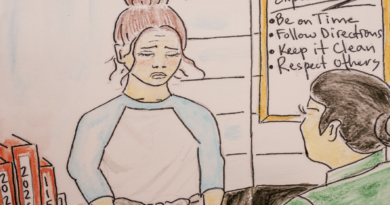
Many of us are positive programmers and typically attend multiple programs in one day. This means we are on go-mode all day. I see the women off to work early in the morning. After work, I see the same women trying to cover their skin from the harsh sun with sheets and fabrics as they walk to their next program.
They are continually coming and going from college, groups, meetings, or other assemblies that support their rehabilitation along with the facility’s well-being.
The high temperatures and harsh conditions have a negative effect on the positive programming we strive to accomplish. With little to no relief after being in the hot sun day after day, we begin to wear down.
There is no reason the rehabilitating population here at CCWF should have to endure another summer without something cool and consistent to come back to at the end of a scorching summer day.
It is reasonable. It is doable. I hope it is time.