Cultivating growth with grace
CCWF’s favorite garden angel: Lauren Beatty

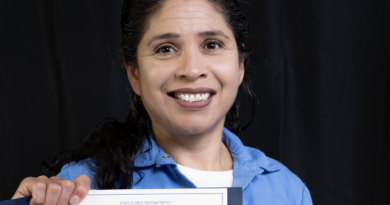
She appears at Central California Women’s Facility (CCWF) like a modern-day fairy or hipster garden nymph. The day I came to interview her among the garden beds, she was especially stylish, with her black cotton-blend overalls, black high-neck sleeveless tank top, and bulky patent leather boots. She looked like she was going to a concert, not pulling weeds.
Her long brown hair cascaded down her back from underneath the straw hat that she wears faithfully while tending the garden. Underneath the brim, I caught a glimpse of her kind, fair-skinned face, deep-set blue eyes, full lips, and a smile that can light up the darkest of places. This is CCWF’s Main Yard Garden’s little ray of sunshine: Lauren Beatty.
Whether CCWF residents are new to the gardening world or longtime “green thumbs,” Beatty makes them feel at ease with her down-to-earth personality and her excited energy about the plants and their purposes. Beatty’s concern for the earth and humanity is beautiful in contrast to somewhat dim prison conditions.
Beatty was born in February 1989 in Utah. When she was two years old, her dad lost his job, and his addiction to alcohol became more present. Because they were in need of support, the family moved to California to stay with relatives.
Like most of those at CCWF, her life wasn’t exactly a fairytale. However, Beatty is an example of the strength and resilience that we all have the full potential to achieve. She builds up other women with her knowledge, empathy and kindness. And her approach to building human potential is literally rooted in the earth. “When we heal the land, the land heals us,” Beatty said.
Beatty got into land work as a response to seeing “how much our world is hurting,” she said— climate change, natural disasters, food insecurity, people being displaced, and ecosystems collapsing. “Once I understood the depth of it, I couldn’t just sit back and do nothing,” Beatty said. She completed a Bachelor of Applied Arts and Sciences with an emphasis on regenerative and sustainable living, and is now pursuing a Master’s of Science in regenerative organic agriculture from Maharishi International University. She expects to graduate next spring.
Beatty first worked with the unhoused women’s community in Fresno, teaching gardening, yoga, and meditation. In 2021, when the position as CCWF program manager for Land Together— formerly called Insight Garden— opened up, it was a natural next step, she said.
Land Together started around 23 years ago as a prison-based garden program, and they’ve been at CCWF since 2017. Recently, they also added re-entry services for newly released incarcerated individuals.

According to their website, the organization’s mission is “to cultivate justice and belonging by nurturing deep connections to nature, self and community for people impacted by mass incarceration.” Because Land Together sees “access to nature as a human right,” they break down access barriers to nature inside and outside the prisons. If the powers that be continue to cover the world in concrete, we will lose the connection forever.
Beatty was introduced to the prison garden through her husband, who was then an Insight Garden volunteer. The value of gardening in prison was immediately clear to Beatty.
“I was drawn,” she said, “because I believe everyone deserves access to beauty, to genuine connection to the land, to the ability to nurture and grow plants, and be in nature. Because we are nature.”
Individuals who participate in CCWF’s Land Together group are encouraged to learn and adopt new positive lifestyle choices through gardening and studying a curriculum on planting, harvesting, native plants, and much more. Most importantly, they learn to tend the precious gardens of their minds, choosing to “weed” out the bad choices and negative people.
The power of cultivating gardens at a women’s prison, specifically, is not lost on Beatty. In May 2025, she gave a talk at the convention for Seed Savers Exchange, a nonprofit that focuses on storing, recording and preserving heirloom seeds.
In her talk, titled “The Hands That Hold Tomorrow,” Beatty explained her belief that women are the keepers of culture, that there is a feminine urge to care and nurture, and that as women, we naturally have a connection with creation.
She said that throughout history, women have widely held and passed down the knowledge of plants and herbalism through countless generations. Still, “historically, women have been left behind when it comes to opportunities, especially in land-based practices,” Beatty said.
Many famous women inspired her to “push the status quo and fight for space and equality,” she said. That includes Jane Goodall, Vandana Shiva, and Maya Angelou, whose quote Beatty turned to—“When you learn, teach. When you get, give.”
As women and mothers estranged from their children and loved ones, it’s important for us to have a connection with our feminine nature to nurture and care for other living organisms. This is why Beatty and her colleagues are guides on the path to healing; they help reconnect the participants to their vital link to the planet, or, if you’d prefer, Mother Earth.