Parenting an incarcerated child
How it feels to be the mother of a child who is serving a long-term sentence in prison

Once or twice a month, Lourdes Calderon drives more than 50 miles from Visalia to Central California Women’s Facility (CCWF) in Chowchilla, California to see her daughter Chaylin Funez. The drive takes approximately an hour and 10 minutes each way. These visits are the only time they can be face-to-face for an extended time.
The two of them willingly navigate the distractions of being in a large visiting room surrounded by other people and constantly watched by correctional officers and cameras to maintain and strengthen their relationship. While the drive is challenging for her, Lourdes is grateful knowing her daughter is alive and is being productive while she is incarcerated.
Chaylin, 26, is the fifth and youngest of Lourdes’ children. She was arrested in 2018 at age 18 and is currently serving a life sentence. Chaylin’s time in the Tulare County Jail was the first time she and her mother were unable to touch. Lourdes was only able to see Chaylin during her court appearances from a distance.
Lourdes and Chaylin both realized what they’d taken for granted and how easily their time together was drastically changed. Lourdes was used to having her daughter nearby and to being involved in her life daily. Chaylin would sometimes do Lourdes’ hair and nails and would constantly check to make sure Lourdes was eating well and taking care of herself. By her own admission, like most teenagers, Chaylin would be difficult at times — something she now regrets — but her mother was a part of most things in her life and was always there when Chaylin needed her.
When asked separately about some of the challenges they face, mother and daughter expressed very similar feelings. What stood out was the anxiety they both feel leading up to and on the day of their visits. They both worry about Lourdes’ health, traffic safety, weather, financial expenses, sudden obstacles that may prevent the visit, and the emotional toll when it is time for Lourdes to leave.
But more than anything, they both experience happiness and excitement at being together for the day.
Lourdes often thinks about Chaylin growing up. She recalled how loving, compassionate, and committed to God her little girl was. Lourdes was in awe of the way Chaylin would look at unhoused people and beg to go back and bring them food. Chaylin also had a soft spot for animals, and Lourdes credits that to Chaylin’s belief in God and knowing that He created all living things with love. Chaylin wanted to share that love all the time.
The biggest difficulty each of them faces is the overwhelming emotion just prior to and at the end of each visit. “I feel this emptiness in my chest… it is painful. I experience sadness. It is a feeling that has no name,” Lourdes said.
“As a mother, to see her daughter in prison is unexplainable. The visits for me are comforting,” she added. “To be able to hug her, touch her; but when I return home, I cry…I cry on my way back.”

Chaylin feels guilt and shame when she sees her mother’s tears as the visit comes to an end. “I miss her a lot. My mom was the one who was fully solid in my life. It’s hard to know how much it hurts her, my being here.” Thinking about the past, Chaylin asked, “Why didn’t I listen to her? She was [always] right!” then smiled wistfully.
Lourdes said, “It is always so difficult to know I have left her there, in the prison. It makes me so sad.”
Despite the emotional pain, both women agree that their visits are wonderful. Lourdes added, “Seeing Chaylin in person is a blessing — a miracle.”
Once Chaylin has confirmation — on the day of — that her mother is on the way to see her, her impatience grows as she waits for her housing staff to call her. Then she knows her mother has arrived safely, and it will only be a short time until they are together.
The moment Chaylin sees her mother in the visiting area, she experiences a warm joy and feels safe. “Nothing matters here — only outside really matters,” she said. Chaylin appreciates and greatly values the way their relationship has grown and the way they are able to communicate with each other. She sees where her maturity has allowed her to be vulnerable in their conversations, and enjoys getting to know her as a person, “not just as ‘Mom.’”
Lourdes and Chaylin use their time discussing things they experience in their respective daily lives, keeping updated on other family members and friends, reminiscing on the past, and planning for when they are together after Chaylin is released. They have already formed plans for Lourdes to cook pollo con tajadas, tamales, tajadas de nino verde, and tajadas de plantino — all Honduran food from their country of birth — for Chaylin.
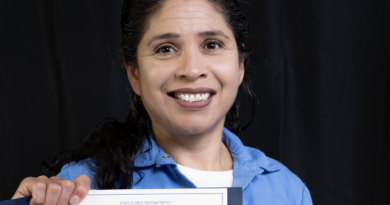
Lourdes remarked on the changes she has seen in Chaylin over the last eight years and is very proud of her. “When Chaylin graduated from the Occupational Mentor Certification Program, I was so very happy on that day. For this, I was crying tears of joy.”
The greatest plan for Lourdes is to know that her little girl is finally home. “I can’t wait ‘til the day comes that [Chaylin] comes through this door, hugs me, and tells me ‘I’m here, Mommy,’ and we are here together once again.’”