Racial Justice Act explained
Ella Baker Center for Human Rights provides information to CCWF residents regarding new legal pathways

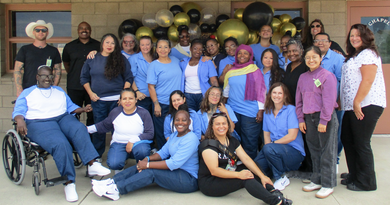
On Saturday, March 14, 2026, the Ella Baker Center for Human Rights (EBC) came to Central California Women’s Facility (CCWF) to ensure incarcerated individuals had access to important information about new and existing resentencing procedures in California.
Morgan Zamora, the prison advocacy manager for EBC, stood at the front door, greeting everyone with a smile. That first interaction set the atmosphere for the day.
“It is important to all of us at the Ella Baker Center to explain laws and resentencing procedures, and what those pathways may look like for the incarcerated,” Zamora said as she opened the event. “Today, we will be focused on the Racial Justice Act (RJA) and how it specifically impacts Black and Brown people in the criminal justice system, and other resentencing laws.”
There was also a Spanish-speaking group seated toward the back of the gym, where translators made sure the information was accessible to as many as possible. The main message of the event was that people cannot advocate for themselves if they do not have access to the information they need.
“The [RJA] passed in 2020 and is designed to challenge systemic racism. It is especially significant for Black and Brown communities who have long been disproportionately impacted by unequal treatment, harsher sentencing, and systemic barriers within the criminal justice system,” Zamora said.
Jennie Rose Nelson, a legal fellow from the University of San Francisco Racial Justice Clinic, said,“Everyone is entitled to a trial free of racial bias.”
Nelson discussed new amendments to the RJA, such as: discovery is permitted before filing an RJA petition, there’s a lower threshold for appointment of counsel, and a copy of the motion must be served on the law enforcement agency that employed the officer. Nelson also shared troubling statistics about racial disparities in the criminal justice system.
Nelson elaborated on what Zamora said by breaking down key information about the RJA, such as the four grounds to resentencing: bias against the defendant; racist statements and implicit bias at trial; over-charging: higher charges compared to other races; and over-sentencing: higher sentences compared to other races. Nelson also warned participants about the risks involved in submitting a habeas corpus petition, such as that filing an RJA petition will likely prevent a person from raising any other habeas claims in the future.
The focus of the event shifted more broadly to resentencing. EBC organizer Philippe Kelly and Policy Director Eric Henderson encouraged residents not to give up hope. They spoke about different routes a resentencing case may take, including resentencing referrals from the California Department of Corrections and Rehabilitation (CDCR), or the District Attorney (DA).
Their message was one of persistence. Whether someone pursues CDCR or DA referrals for resentencing or another form of relief, Kelly and Henderson emphasized that these efforts often require patience, determination, and repeated advocacy.
Jacquelin Linares, a Spanish-speaking resident at CCWF, shared her appreciation for the event, saying that she appreciated that EBC came and gave information that she did not know previously.
Kristen Umathum, another CCWF resident, spoke to the urgency and need for legal education inside prison.
“I am getting ready to file for resentencing and I want all the information the Ella Baker Center provides,” Umathum said. “How can we help ourselves if we do not understand what those pathways look like?”
Resentencing laws offer limited hope if people do not know the process, the requirements, or the options available to them.
CCWF residents left the event a little more informed and at peace with the knowledge they had gained.