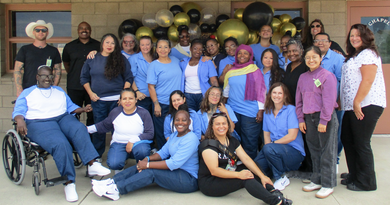
Residents celebrate accomplishments at Substance Abuse graduation

Changing one’s thoughts and behaviors is difficult. Being vulnerable and choosing to heal from past traumas is exponentially more difficult.
On Thursday, June 12, 2025, brave incarcerated individuals at Central California Women’s Facility (CCWF) who completed those difficult tasks graduated from the Integrated Substance Use Disorder Treatment (ISUDT) program. ISUDT classes cover topics such as victim impact, parenting, and criminal and addictive thinking. The ISUDT program is overseen at CCWF by Correctional Counselor III Flavella Singleton, a 17-year veteran of the California Department of Corrections and Rehabilitation.
Graduates numbered 166 in total, so two ceremonies were held to acknowledge their accomplishments.
The visiting room was decorated with black, white, and pink balloons. Multiple rows of chairs lined the right side of the room for graduates, while three rows of chairs for staff faced them. For each ceremony, “pomp and circumstance” played while graduates walked into the room. Incarcerated mentors from the Occupational Mentor Certification Program (OMCP) clapped and cheered the graduates during the procession.
Although all graduates wore the same black cap and gown, some incarcerated individuals expressed their unique style by wearing scarves, cooling towels, or flowered leis around their necks.
Singleton welcomed the ISUDT graduates to the ceremony, as well as staff from both CCWF and Amity Foundation, the organization responsible for providing the ISUDT curriculum. She told graduates not to let completing the ISUDT program be the last thing they accomplish, and encouraged them to “be a role model to loved ones.”
Val Ferrell, Amity’s former program director for CCWF, referenced the difference between sobriety and recovery, and noted that, “you alone can do it, but you can’t do it alone.”
Peter Chamberlin, Ferrell’s guest, congratulated the graduates on their accomplishments.
“You didn’t just complete a program, you made a decision to invest in yourselves… even in the hardest places, transformation is possible,” Chamberlain said.
Addressing her classmates during the second graduation, Eva Fierro said that although she hadn’t originally wanted to participate in the ISUDT program, “we end up getting something out of it whether we want to or not.”
Singleton then retook the stage and shared that ISUDT has a tradition for graduates: instead of moving tassels or throwing caps into the air, graduates toss balloons above their heads to celebrate. Once each graduate came forward to shake hands and take a photo, more than 80 balloons became airborne, bouncing from hand to hand while participants laughed and cheered.
As a special commemoration, graduates were given colorful rubber bracelets with affirmations printed on them. “Look at them when [you’re] feeling down,” Singleton said.
Warden Anissa De La Cruz took time from her hectic schedule to attend the first graduation of the day.
“This program isn’t easy,” she said. “It asks participants to be honest, open, and determined. Recovery is a journey, not a destination. I’m proud of all the graduates.”
The event drew a supportive crowd of attendees, including those with direct roles in aiding the program.
“Being part of these graduations feels amazing,” said Amity Demonstrator Tamara Gadriel. “We build relationships with the people in the program, and I’m super grateful to be part of their journeys.”
Attendees also reflected on the power of the program.
“ISUDT was very motivational to me. It taught me how to communicate and deal with my feelings,” said graduate Kwana Harris.
All graduates were given a ticket allowing them to take a Polaroid photo, either by themselves or with a friend. Incarcerated individuals lined up to be photographed in their caps and gowns, some planning to save theirs as a keepsake, while others planned to send theirs home.
Before graduates returned to their housing units, OMCP mentors served them barbecued hamburgers, hot dogs, chips, sodas, and cake.
“This is a very important event,” said graduate Hillery Titsworth. “It shows the struggle is worth it and that growing is meaningful. I feel a sense of accomplishment.”