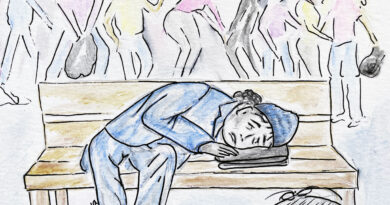
From lifer to law school
Keeairra Dashiell’s childhood dream just came true

Keeairra Dashiell always dreamed of becoming a lawyer, but in 2013, she was sentenced to 19 years to life. After serving 14 years of her sentence, she paroled in 2021 and decided to continue chasing that dream.
Dashiell enrolled in law school six months after her release. She attended People’s College of Law in Los Angeles for three years and finished her fourth year in the California Law Office Study Program. She graduated in May and took the bar in July. Dashiell’s dream is to practice civil law.
In November, Dashiell passed the California Bar Exam. Now, she has to pass a moral character test. Every step she takes brings her closer to fulfilling her childhood dream of becoming a lawyer.
Q: What was it like living in South Central Los Angeles?
A: It was tough. It felt like a constant battle against circumstances that were out of my control. The community was resilient, but the systemic barriers made success feel almost impossible.
Gang violence and poverty weren’t just things you heard about; they were a part of everyday life. Survival came before dreams because, honestly, dreaming didn’t feel like an option when you were just trying to make it through the day.
Without guidance or positive role models, it was easy to get caught up in the cycle of crime and hopelessness. But in the midst of it all, there was always a deep sense of strength in the community. That strength is what fuels the work I do today. I know firsthand that when people are given the right opportunities, real change is possible.
Q: Did you always dream of becoming a lawyer?
A: Yes. My father was incarcerated when I was young, so I heard the word “attorney” a lot growing up. Back then, I thought attorneys were people who got other people out of prison, and I wanted to do that for my father. That idea stuck with me. I was a straight-A student and education was something I took seriously. Before my incarceration, I was a political science major at UC San Diego, already on a path that could have led me to law school. But life took a different turn. Even though my journey was interrupted, that dream never really left me.
Q: Did you stop dreaming after your conviction?
A: There were moments when hope felt distant. Being sentenced to life can make you question everything — your worth, your future, and whether a future is even possible.
But I held on to faith. Jeremiah 29:11, my favorite scripture, says, “For I know the plans for you, declares the Lord, plans to prosper you and not to harm you, plans to give you hope and a future.” That’s a reminder that my story wasn’t over, even when it felt like that.
Instead of letting the system break me, I used my time to rebuild myself, learn, and prepare for a future beyond prison walls.
Change did not come all at once; it came in small moments. Change became possible for me when I was in a room full of women and [saw] that people had the same trauma; people with the same circumstances opened the possibility of me feeling different inside.
This internal change fueled me to decide to do better. I made a choice to seek change through self-help therapy groups and being of service to my community [through] organizing and coordinating events to promote community empowerment.
Q: Do you view your incarceration as an asset or an obstacle in pursuing your dream?
A: My incarceration gave me a perspective that no law book ever could. It made me understand the legal system from the inside out. It gave me the ability to connect with people who feel unheard and to advocate for those who are often overlooked.
My past isn’t a weakness. It’s my greatest strength. When I walk into a courtroom, I will not just be another attorney. I will be a living testament to the fact that redemption is possible and a reminder that no one is beyond transformation.
During my incarceration, I developed critical skills that became transferable assets in my journey toward becoming an attorney. I served on the Inmate Advisory Council, acting as an advocate and liaison for the incarcerated population. That experience showed me firsthand the importance of legal advocacy and made me realize I had to do more. I honed my ability to navigate complex policies, mediate conflicts, and negotiate with prison officials — skills that directly translate into the legal field.
Everything I went through, every challenge I faced, became a stepping stone rather than a roadblock. My lived experience gives me an edge — an ability to understand legal issues beyond therapy and a relentless drive to fight for justice.