Compassion in Corrections
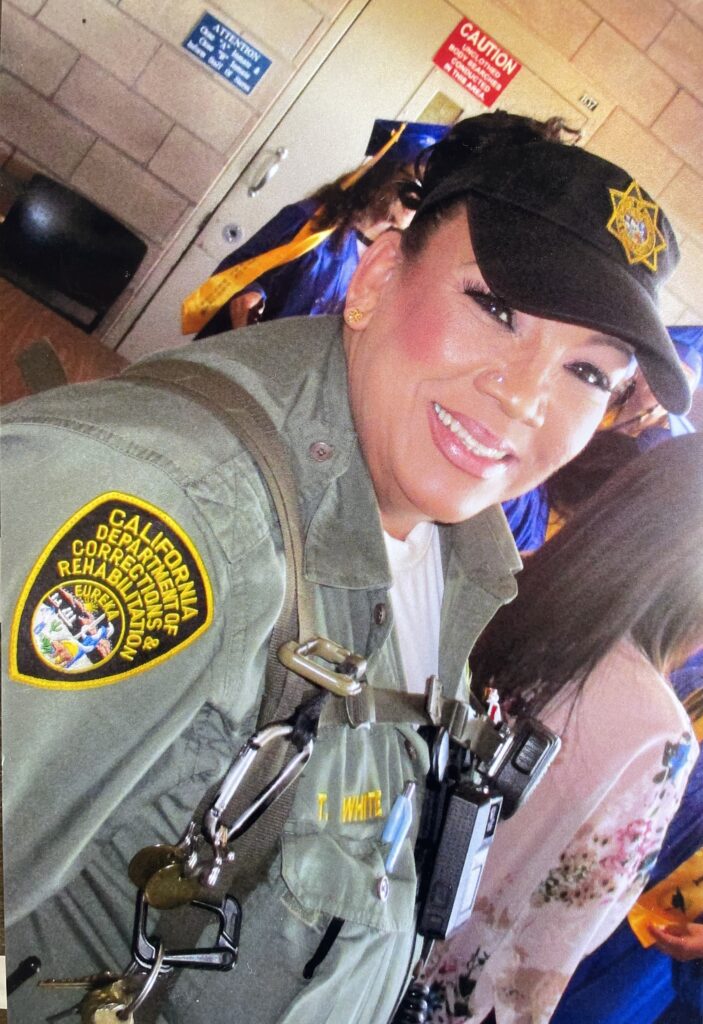
Corrections Officer Teresa White is making a difference in CCWF
“Always be humbled and gentle. Be patient with each other, making allowance because of your love.” Ephesians 4:2
In the world of corrections, most think the role of a correctional officer is to strictly enforce the rules and maintain order. However, there are officers who go far beyond their basic duties by embodying compassion, support, and humanity in their daily interactions with their peers and incarcerated individuals.
Teresa White is one of those officers, and her approach to corrections is making a lasting impact on the incarcerated.
White has been working in corrections for 24 years; five years at Salinas Valley State Prison and 19 at Central California Women’s Facility (CCWF).
White did not consider the job an option until her baby brother, Roy, was incarcerated. He told her that she would make a great officer because of her fairness and honesty, and she “wouldn’t treat the incarcerated like dogs.”
White has been living up to her brother’s expectations ever since. “Compassion is important in corrections,” White said. “It makes us human. We should not be robots working here.”
White currently works as the Integrated Substance Use Disorder Treatment (ISUDT) Division as a Rehabilitative Programs Officer. One of her main tasks is to keep the area secure. White also adds harmony.
“Good morning, love,” White greeted one of the ISUDT porters, Sholanda Thomas, on a Tuesday in May, as she was passing by.
“She drives me crazy with her music blaring out loud,” White said. “I don’t want her ears to be affected.”
Thomas said that White respects the incarcerated, and she can always count on her being straightforward.
“People tell me what I want to hear to pacify me when I am messing up,” Thomas said. “I do not need BS. I need honesty. White gives me that.”
“If she sees you stuck at the gate in the heat, she will open it for you,” Thomas said. “She would even refill your water bottle when she sees you’re thirsty. That is who she is. She cares.” White motivates Thomas and, most importantly, “she believes in me,” Thomas said.
White said she hopes she makes a difference in the incarcerated population’s lives. She prides herself on building them up. “Even when they come cussing me out, when they are having a bad day, I want them to know that I see them. I try to uplift them,” White said. “I have my bad days too, but we can do it together. We can uplift each other.”
People who inspire White are regular people who have made a significant transformation. One such person is her brother, now a free man.
“He was so down, [but] he was able to rise up and become the brother he was born to be,” White said. “If my brother can do it, my girls can too. “
She recently witnessed some of the incarcerated people she works with graduate from California State University, Fresno. Her eyes filled with joy when she talked about resident Eileen Huber.
“She didn’t used to believe in herself,” White said. “Look at her now, a graduate. I am so proud, like a proud grandma.”
Porchia Chisom, a CCWF resident, was recently hospitalized with pneumonia, valley fever, and was septic. She was on a ventilator and in critical condition. Officers would take shifts to observe Chisom for security reasons. Chisom shared how White talked to her, comforted her, and played a movie for her.
“If it wasn’t for Officer White watching over me when I was in intensive care, I don’t think I would have made it,” Chisom said, tearing up. “Her words made me feel that I can make it through. She made me feel like I mattered.”
Unlike the stereotypical image of an authoritarian “mind your business” type of officer, White believes in treating every individual with dignity and respect. She understands that many incarcerated individuals come from backgrounds of trauma, hardship, and lack of opportunities.
“White makes sure everyone has a good day,” one of her colleagues, Officer R. Ibal, said. “She brings light to her environment.” When Ibal was asked to give an example of White’s kindness and compassion, she said: “She is the example. She displays kindness and compassion every time you see her.”
A supportive officer can provide reassurance and direct residents to resources that promote emotional well-being, according to Lt. Monique Williams, who has also served in the department for 24 years.
“The legacy Officer White is leaving and displays is the type of culture change within CDCR and CCHCS that is needed to bridge the gap between those who work in and live in the institution with kindness, authenticity, autonomy, and grit to do a great job with a beautiful smile sowing seeds of wholeness, joy, and consideration,” Williams said.
“CDCR is slowly changing in a positive direction, and I am seeing it at the end of my career,” White said. “God says we are all brothers and sisters, no matter where we come from. I am not perfect. No one is, and when we make a mistake, we must move forward and be better.”
The advice White wants to give to the young officers is: “Stop, slow down, and start listening. Do not be quick to say no. The population just wants to be heard.”
White is planning to retire soon and is excited to be a professional grandma.
We need more officers like White. While discipline and security are crucial in correctional settings, compassion should not be overlooked. Officers like White prove that kindness does not equate to weakness; rather, it is a powerful tool in creating safer and more rehabilitative institutions.