Why saving lives is becoming a bummer

“Can you hear me? Can you hear me?” I asked one of my peers while shaking her shoulders.
There was no reply to my voice, nor was there a reaction to me firmly rubbing the middle of her chest with my knuckles. She was stiff. Her body had locked up, arms extended out, frozen in a half-seated embryo position without any signs of vitality, eyes peeled white, mouth blue and foaming at the corners.
“Shit! Not again!” I knew to use my Narcan on her immediately. Even though she normally gets mad at me for ruining her high, I was not going to take any chances.
According to the Centers for Disease Control and Prevention, Narcan, or naloxone, is a fast-acting opioid antagonist used to reverse overdoses and save lives within minutes. As a harm reduction technique, it is critical in buying time, not just for survival, but for potential recovery as well. Narcan is often the first line of defense in preventing fatal overdoses.
The Food and Drug Administration approved Narcan, allowing for rapid administration by first responders in the field without extensive training in 2015. The CDC recommended that all states develop policies that allow the widest possible availability of intranasal naloxone for the immediate reversal of opioid overdoses.
It was a slow evolution of who can carry Narcan. It started with licensed vocational nurses (LVNs) and psychiatric technicians in June of 2017, then correctional officers and correctional supervisors in November of 2018. Now it has expanded to us, the peers, having unlimited accessibility, because we are the first responders.
I see Narcan everywhere. It is as common as a fire extinguisher, if not more common — a symbol of how normalized opioid overdose has become. If you don’t believe me, come to one of the housing units and you will see this 3 feet tall by 1.5 feet wide purple newspaper dispenser sitting next to a bin of toilet paper rolls and feminine products. We need these products daily.
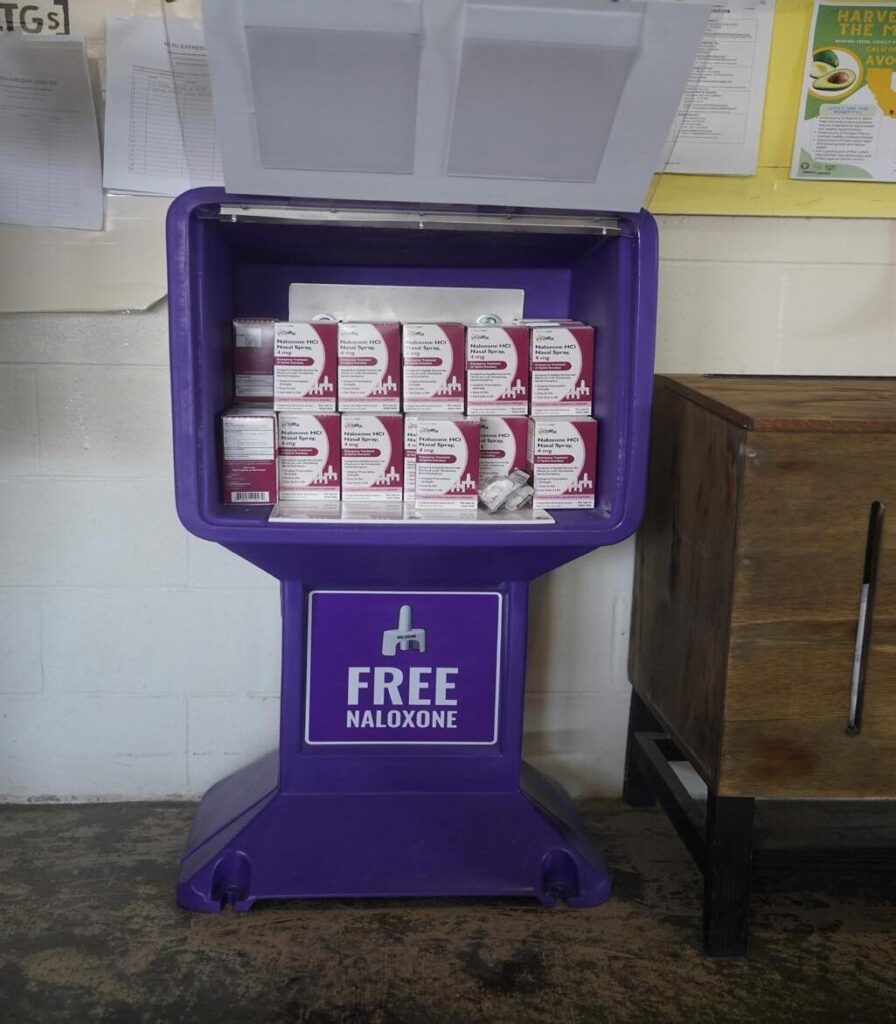
Narcan is beneficial in a lot of ways: it saves lives instantly, it is non-addictive and safe, and it could ultimately be used as a bridge to treatment opportunities. But with its accessibility comes a false sense of security, which leads some of my peers to use it more recklessly, relying on their buddies to revive them when they drop.
A. H., who asked not to be iden tified for fear of repercussions, a CCWF resident and a regular opioid user, said that it is not her peers’ responsibility to revive her; however, by reviving her, she believes they somewhat care about her. She said she uses in her room so she can get assistance, but when she gets the assistance, she gets upset because it ruins her high.
“It feels good, so I will continue doing it for now,” A. H. said. “I do hope one day I would stop. I know I am hurting the people that love me. Seeing their hurt hurts me and is my only motivation to keep going and try to do better.”
One of A.H.’s loved ones told her, “What worries me the most is you going home not answering when I call, because you are too high, too numb, or dead.”
“I am an addict and it feels easier to hide my emotions with drugs than feel and face them,” A.H. said. “Reality is scary. When I use, I feel stillness and calmness — a state reality doesn’t offer me.”
Using Narcan on my peers often affects me emotionally, especially when it is a loved one. And it does not address the root causes of drug addiction, trauma, and lack of support.
These repeated revivals can create moral fatigue and burnout. However, without it, lives could be lost in a place that promotes rehabilitation.
The same people are revived repeatedly. The deed that began as compassion has slowly turned into emotional numbness and frustration.
Sometimes I ask myself, “Why am I doing this if that person is going to continue doing the same thing?” However, addiction often is not about choice — it is about chemical dependency, trauma, and compulsion. Nevertheless, the emotional toll is real and rarely addressed.
J.D., lifer,long-term opioid user, and resident of CCWF said, “When you have a Narcan, you place yourself in a first responder situation.”
She told her roommates, “If you see me fall out, leave me for a few minutes before you Narcan me. They do it anyway, and then I go into withdrawals, especially when I have to wait 24 hours for another dose.”
I get it. Narcan saves lives and displays awareness and preparedness; however, it also begs the question: Are we just adapting to something that is broken instead of fixing it?
I look around me, and my peers are becoming desensitized. What was once shocking and hurtful is now expected. This “new normal” standardizes suffering and perpetuates a vicious cycle where revival replaces recovery as the end goal.
“I am traumatized, my peers are traumatized, we are all traumatized,” J.D. said. “Another trauma is not gonna make a difference in the trauma cycle we live in.”
I realize that Narcan is not the actual issue — it is a lifeline. However, when a lifeline becomes routinely used, it takes away from the goal of recovery and ultimate freedom.
Correctional officers should be placed in the position of first responders, and certified alcohol and drug peer counselors should be utilized for aftercare. Harm reduction is essential, but what is equally as essential is investment in mental health support, trauma care, proper housing, and treatment. Without these components, we will keep reviving without truly rescuing those trapped in addiction.