Program modifications distress incarcerated individuals
How rehabilitative programming determines one’s state of mind
Modified program has increased in Central California Women’s Facility (CCWF) to levels not seen since the COVID-19 pandemic when staff illness, contact tracing, virus exposure, and even staff retiring, were prevalent. Between 2020 and 2023, residents of CCWF began to hear more announcements regarding modified program. But even now, when the pandemic has subsided, incarcerated individuals at CCWF continue to experience reductions in time spent out of their rooms.
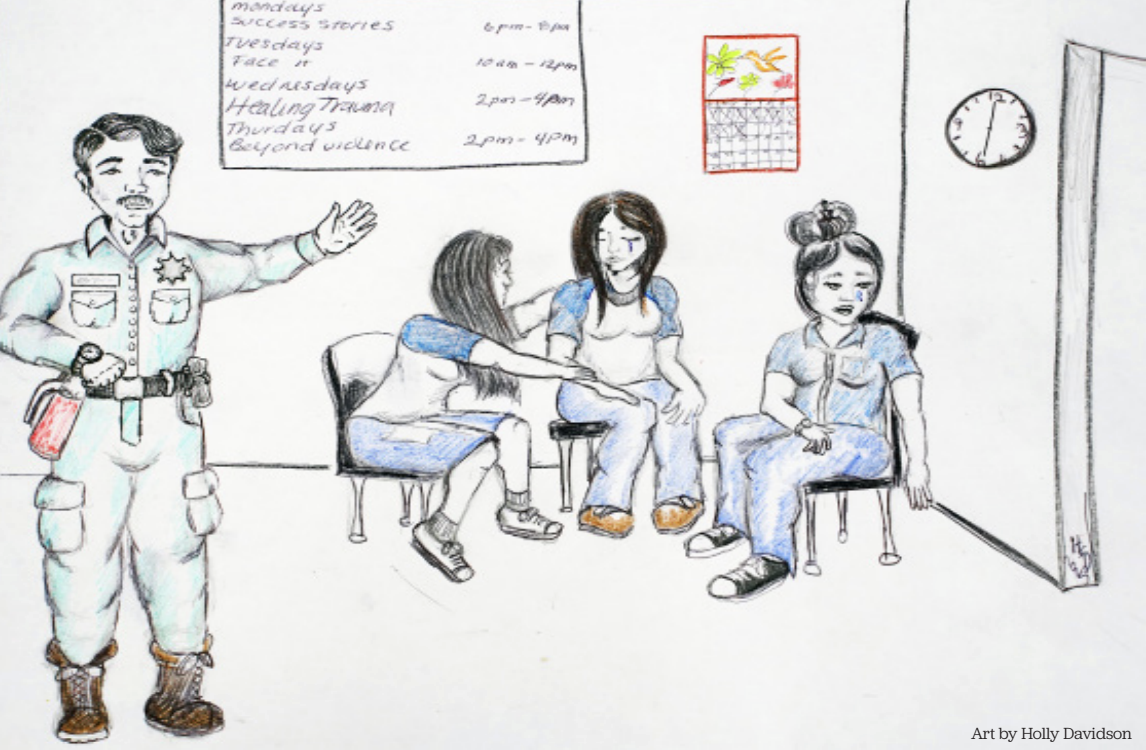
“Modified program” means that there will be no dayroom or yard access during that shift. Incarcerated individuals will be confined to their rooms unless going to work, school, or a priority ducat (a written authorization for movement).
“Not being able to go anywhere but work makes me feel less than human,” said CCWF resident Jizette Nahapetian.
Numerous staff claim shortages are due to institutional need such: as medical transport or off-site appointments and staff redirects. For example, if there is no officer assigned to supervise the Substance Abuse Program (SAP) participants, an officer from a housing unit is redirected to supervise the SAP participants, which means the housing unit is modified.
State budget cuts in 2024 impacted CCWF residents severely: staff positions were deleted on third watch, the shift from 2 p.m. to 10 p.m., when most individuals are not at work or school and could access the yard. The lowered staff numbers mean less yard program opportunities in the afternoons and evenings. The chance to exercise or just meet with a friend from a different housing unit decreased exponentially.
Multiple news agencies, including CalMatters, Los Angeles Times and even Gov. Gavin Newsom’s own website, reported on the budget cuts and how they would impact the California Department of Corrections and Rehabilitation (CDCR).
Specifically, CalMatters reported in February 2024 that “officials acknowledged that budget constraints could affect inmates’ access to outdoor time, group classes and rehabilitative services — especially at larger facilities like CCWF.”
“I like to work out and I participate in groups. But I can’t participate in groups because they say we’re modified and no groups can be held in the building,” said CCWF resident Valerie Nessler.
Nessler recounted a recent experience regarding a group she regularly attends. The facilitators for the group drove to CCWF from Los Angeles — a commute of approximately four hours. All participants were assembled and ready to begin, but “a sergeant came into the group and cancelled it at 6 at night,” she said. “We were supposed to meet the next day, but group was cancelled again. They drove all the way from Southern California just to be cancelled twice. It’s really hard on my rehabilitation.”
In April 2024, the L.A. Times cautioned, “Analysts warn that reducing funding to these core services [healthcare and rehabilitative programs] could exacerbate mental health issues, increase recidivism and strain already understaffed facilities.”
According to the American Psychological Association and the Vera Institute, there are direct correlations between less time outside of one’s cell and increased agitation, irritability, aggression, and even verbal or physical altercations.
“We are locked down all the time, and it’s stressful. It gives us anxiety and depression,” said Nahapetian. Nahapetian is an Inmate Advisory Council representative for her housing unit, tasked with serving as a liaison between staff and the population. “People in my unit are always asking me why we’re locked down, when can we come out, when can we have yard,” she said. “Everyone just wants to know why this is happening.”
Nessler seconded Nahapetian’s sentiments: “I feel very isolated. I feel stagnant. I can’t get any movement, so I start to get depressed.”
On May 15, 2025, incarcerated individuals at CCWF learned that their program time would be further impacted when local officers’ union president Bobby Orosco distributed a memorandum of understanding (MOU) stating that incarcerated individuals will be locked in their rooms from 1:30 p.m. until 2:15 p.m. to conduct shift change.
The MOU says, “This change will allow staff to report to their posts without being surrounded by inmates [sic] with no equipment on, conduct proper security checks, review log books and make necessary preparations for their shift in a safe controlled environment. This is a critical step forward in improving safety and operational efficiency for staff.” However, during the 35 years CCWF has been operational, shift changes have occurred daily without disruption. Officers routinely come on grounds, walk to their posts and exchange equipment.
The CDCR Office of Public and Employee Communications said, “CDCR’s top priority remains the safety and security of those who live and work in our institutions. While the department is committed to the value of rehabilitative programs, it implements modified programming when there is an elevated threat or ongoing investigations such as after violence, contraband discoveries, or other serious incidents,” which is different from reduced program hours for CCWF residents.
The vast majority of individuals at CCWF work, attend an educational/vocational program and participate in self-help groups. The level of rehabilitative programming accomplished by CCWF residents is tremendous. Shouldn’t they be allowed to go for a walk or have a video call in the dayroom when they’re not at work?